
Why Kenyan Homes Are Switching From Grid Power to Solar
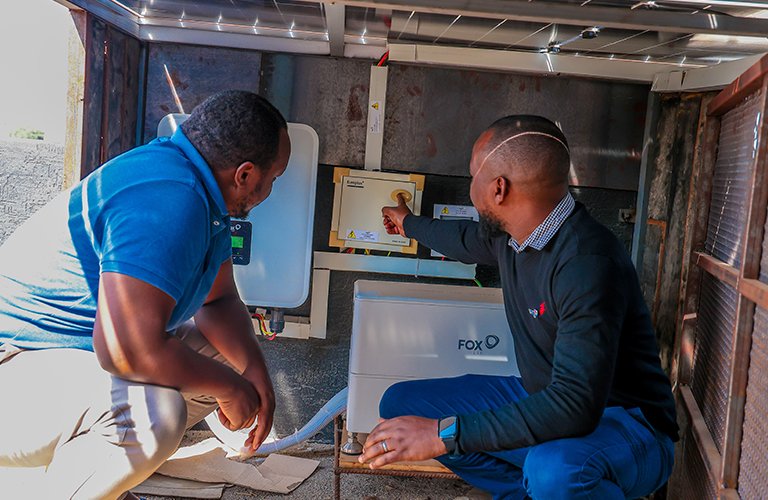
When David Njugi started building his home, connecting to the national electricity grid seemed like an obvious plan. Until he saw the cost.
“The national grid had not yet reached my site, and connecting it would have been quite expensive. Solar was a good alternative,” he said.
Today, his home runs entirely on solar power.
David’s experience is becoming increasingly common across Kenya, and the shift is not just happening in homes.
Businesses across the country are also adopting solar power to mitigate rising electricity bills and frequent power outages. About 2,000 of Safaricom’s 7,000 base transmission stations are now fully powered by solar energy. Commercial developments such as the Two Rivers Mall have invested in large-scale rooftop solar as demand for renewable energy grows.
According to a report by the International Energy Agency (IEA), electricity access has risen dramatically from 37 per cent in 2013 to 79 per cent in 2023. This positions Kenya on course for universal electricity access by 2030. Yet despite this progress, millions of people still rely on off-grid energy.
The report further states that Kenya is now East Africa’s largest off-grid solar market, accounting for nearly 74 per cent of all solar home system sales in the region. One in every five Kenyan households already uses standalone solar systems or mini-grids.
However, buying solar and ensuring it is the right solar system are two very different things.
For David’s wife, Hellen Wangui, embracing solar required some convincing. “I had always heard about solar, but I didn’t believe it was practical,” she recalls.
Read Also: Cledun Realtors Land for Sale in Makutano Mwea at KSh450K
With only a basic understanding of solar, her biggest concern wasn’t lighting. She wondered whether a solar-powered home could really handle the everyday demands of a Kenyan kitchen.
“My husband kept telling me the system could do it. It has been a journey of accepting and testing, and it has been working perfectly.”
Even so, the family has learnt that using solar efficiently requires changing some habits.
High electricity use, such as cooking, ironing and powering other household appliances, is scheduled between 10 a.m. and 4 p.m., when solar production is highest. Once the sun goes down, the family’s electricity consumption drops.
Their experience shows that installing solar is only part of the equation. Choosing the right system and knowing how to use it efficiently is just as important.
This is a lesson Gilbert Mugo has spent years teaching customers.
Before setting up Keru Solar in 2024, Gilbert worked on Kenya’s Last Mile Connectivity Programme. The project connected more than 120,000 households across 17 counties through World Bank- and African Development Bank-funded projects.
During that work, he repeatedly encountered communities and businesses beyond the reach of the electricity grid.
Read Also: Echoes of shame: Inside the planning of horrific Homa Bay attack on Sifuna team
“We realised there were still homes and businesses that couldn’t access reliable electricity,” he said.
That experience inspired his move into renewable energy. Today, he believes one of the biggest mistakes homeowners make happens before the first solar panel is even installed.
“Many people focus on how much they want to spend instead of how much power they actually need. They come with a fixed budget and ask for a solar system worth a certain amount,” he says.
Instead, solar technicians should begin by analysing how much electricity the household actually consumes. This is known as system sizing; the process matches a home’s energy demand with the right combination of panels, batteries and inverters.
Skipping that step can be costly as an undersized system struggles to meet a family’s electricity needs while an oversized one can leave homeowners paying for capacity they’ll never use.
For David, that assessment gave him confidence in the system they eventually installed.
“The engineers visited the site, carried out their assessment and designed the system. We agreed on what was reasonable before settling on a 10-kilowatt system,” he said.
Today, David’s modular solar installation continues to meet his family’s electricity needs.
Read Also: TV presenter among 12 sentenced to death in Egypt drugs case
According to the IEA, equipment prices have fallen significantly over the past decade, making solar more affordable and helping drive wider adoption across Kenya.
Gilbert, however, cautions that cheaper should never be mistaken for better and advises homeowners to work with qualified technicians, to insist on proper system sizing, and to invest in quality equipment built to last.
He says a well-installed solar system should serve a household for between 20 and 25 years, making it a long-term investment rather than a short-term purchase.
For Hellen, solar has completely changed her perspective. “Solar works. I didn’t believe it. Now I’m living it,” she says with a smile.