A Century-Old City’s Memories, Renewed with the Warmth of Every Brick and Tile
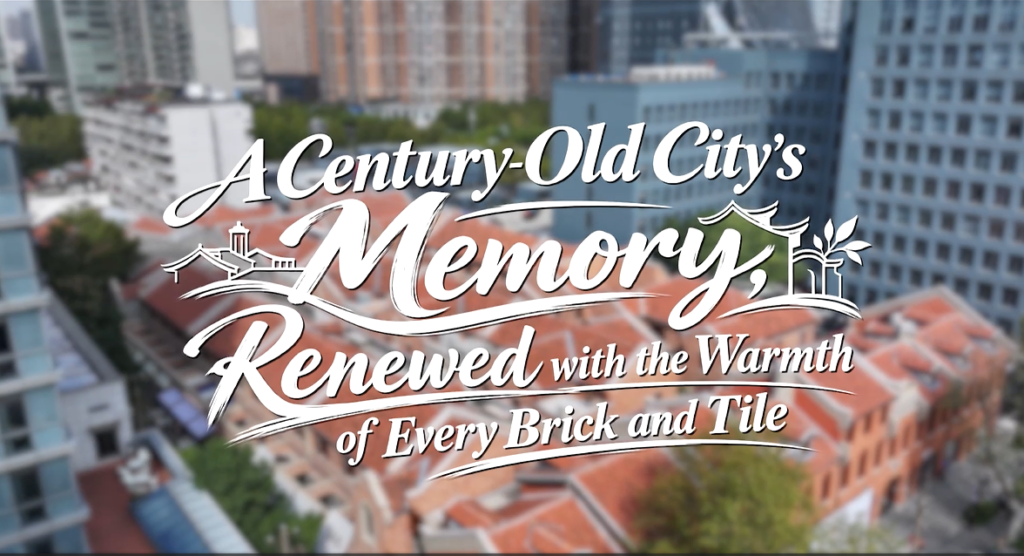
Every city carries its own memories. In Wuhan, they’re written into every brick and tile of the Hankou Historic District
https://www.youtube.com/watch?v=gOTXwxl_zFE
Every city carries its own memories. In Wuhan, they’re written into every brick and tile of the Hankou Historic District. Urban renewal is no longer about large-scale demolition and reconstruction — it is a meticulous process of restoring the old while preserving its original character.
Protecting Historical Appearance
Tang Wei, Senior Engineer, Assistant General Manager, and Head of the Cultural Relics Conservation Engineering Department at Wuhan Tianshi Construction Engineering Co., Ltd., has led the restoration of major projects including Xian’an Fang, Bagong House, the Wuhan Yangtze River Bridge, and the Site of the August 7th Meeting.
According to Tang, for the key features of historic buildings — such as red-tile hipped roofs, timber frames with mortise-and-tenon joints, and the wooden corridors of Bagong House — the construction team only carries out protective reinforcement and surface treatment, without altering the facade’s original appearance. He gives an example: if a wall was originally exposed brick, they restore it using traditional exposed-brick masonry and repair techniques. For material replacement, the team searches across Wuhan and even beyond for period-matching tiles of the same size and specifications.
When restoring the roof frames at Yanqing Li, the construction team first numbered every component before carefully dismantling them. After applying fire, water, and insect protection treatments, they reassembled the structure using mortise-and-tenon joints to restore it to its original form. For the red-brick facades, the team sourced bricks from the same period and in the same style for replacement, while minor damage was repaired using specially formulated brick powder. Tang emphasizes: “What we always adhere to is minimal intervention, restoring the old while preserving its original character.”
Revitalizing the Neighborhood
Xia Liang, Director of the Urban Renewal Management Division (Historic and Cultural City Protection Division) at the Wuhan Municipal Bureau of Housing and Urban Renewal, explains that Wuhan was designated a National Historical and Cultural City by the State Council in 1986 as part of the second batch of approved cities. Today, the city has three major historic areas: the Hankou Historic District, Wuchang Ancient City, and Hanyang Ancient City. Among them, the Hankou Historic District boasts the highest concentration and most prominent display of historical resources across the three towns, with six historic conservation areas, 68 protected cultural heritage sites, and 135 outstanding historic buildings.
In 2020, Wuhan launched the development of the Hankou Historic District, adhering to a combined approach of preservation, renovation, demolition, new construction, and controlled planning. Guided by the principles of “protection first” and “restoring the old while preserving its original character,” the project drives commercial revitalization through organic urban renewal. A number of landmark projects, including Bagong House, Xian’an Fang, and Yanqing Li, have already been successfully revitalized.
Based on the preservation grade, heritage value, and current condition of each historic building, protection, renovation, and adaptive reuse measures have been categorized and refined across a total of 102 projects, with a total investment of 14.4 billion yuan and 10 billion yuan raised through special bond funds. Xia notes that the city is exploring a model where residents contribute funds to participate in the renovation of lane residences and operate them independently, with the goal of “creating an urban public space that visitors must see and residents pass through every day.”
Reshaping the Urban Home
Urban renewal must ultimately serve the people. Cheng Qian, founder of the “Yanxu” brand in Yanqing Li, says she was drawn to the glossy rooftop visible from the second floor — a place that, in this fast-paced society, can instantly bring a sense of calm. She preserved the shop’s original window frames and drapes, allowing the outdoor breeze to flow in and creating a vivid, dynamic sense of space. Cheng Qian says: “Our brand shares the same aesthetic of everyday life as Yanqing Li. Unlike traditional business models, it is much closer to how people actually live.”
“When I was little, just the sight of this Boston ivy would make me feel cool,” remarks Ruan Shijun, a resident who has lived here for over 40 years, as he walks through the lanes of Yanqing Li and gazes at the wall of ivy — a wall of green that has never changed. He has witnessed firsthand the transformation the renovation has brought to the community: infrastructure issues such as water leaks and drainage problems have all been resolved. In Ruan’s view, Wuhan’s urban renewal is about finding harmony between change and permanence. He says, “What hasn’t changed is the ‘Bu Fu Zhou’ spirit of Wuhan people — the spirit of never giving in. What has changed is the face of the city, and this change also embodies the spirit of Wuhan: we must keep pace with the times, have the courage to be pioneers, and always strive forward.”
From those who restore the buildings and manage urban renewal, to those who use the spaces and call this place home — people from all walks of life are weaving together the new future of Old Hankou.
Tang has deep feelings about this. “After the restoration of Bagong House was finished, I would take my child for walks there and tell him with pride, ‘Dad built this.’ But I think rather than leaving something for my own child, what we’ve done is preserve a piece of historical memory for all the residents of Wuhan and for future generations.” As he puts it, restoring the past is to build the present, creating places where people can live in peace. Every protected tile, every cherished alley — they all ultimately become part of everyday life. This is not just Hankou’s story; it is the story that every city that treasures its past is striving to write
Reporter: Hu Yue
An internet-famous check-in spot at Xian’an Fang, Wuhan, Hubei Province, in June 2026
Residents enjoy guo zao (breakfast) on Shanhaiguan Road, Wuhan, Hubei Province, in June 2026