Lessons from China’s Tech-Driven Workplaces
By Brian Lian Kamene
When I first joined StarTimes in Kenya, I was simply beginning my professional career. Four years later, after coming to China to pursue my Master’s degree in Business Administration at China Agricultural University, I found myself back in the same company—this time as an intern in Beijing.
The difference was not just geographical.
In Kenya, I experienced StarTimes from the perspective of a local operation serving an African market. In Beijing, my internship gave me a much wider view of how an international Chinese company connects technology, people, content and operations across different markets.
It also placed me in the middle of a technology ecosystem where artificial intelligence, autonomous vehicles, digital platforms and advanced manufacturing are becoming increasingly visible parts of everyday business.
For me, the experience became an education not only in media, but in how technology is reshaping global business and the workplace.
From the African market to the Chinese headquarters
I officially began my practical education internship at StarTimes Beijing on 6 July 2026.
Because I had previously worked at StarTimes Kenya for about three years, I already understood the company from an African market perspective.
The internship allowed me to see the organization differently.
I was not transferred from the Kenyan operation or returning as a full-time employee. Instead, I was joining the Beijing operation as an intern as part of my MBA practical education.
That distinction made the experience particularly interesting.
I already understood some of the company’s operations, but now I could observe the organization from a different geographical and organizational perspective.
My internship involved script formatting, audiovisual translation, proofreading, voice-over dubbing, and television content production. I worked primarily with Swahili and English and collaborated with Chinese and international colleagues on multilingual content.
I also worked on a range of international television productions, participated in the Swahili talk-show series, and appeared as a main cast member in a programme discussing television productions for audiences back home.
What initially looked like media work soon became a practical lesson in technology, localization and international operations.
Media production in a digital world
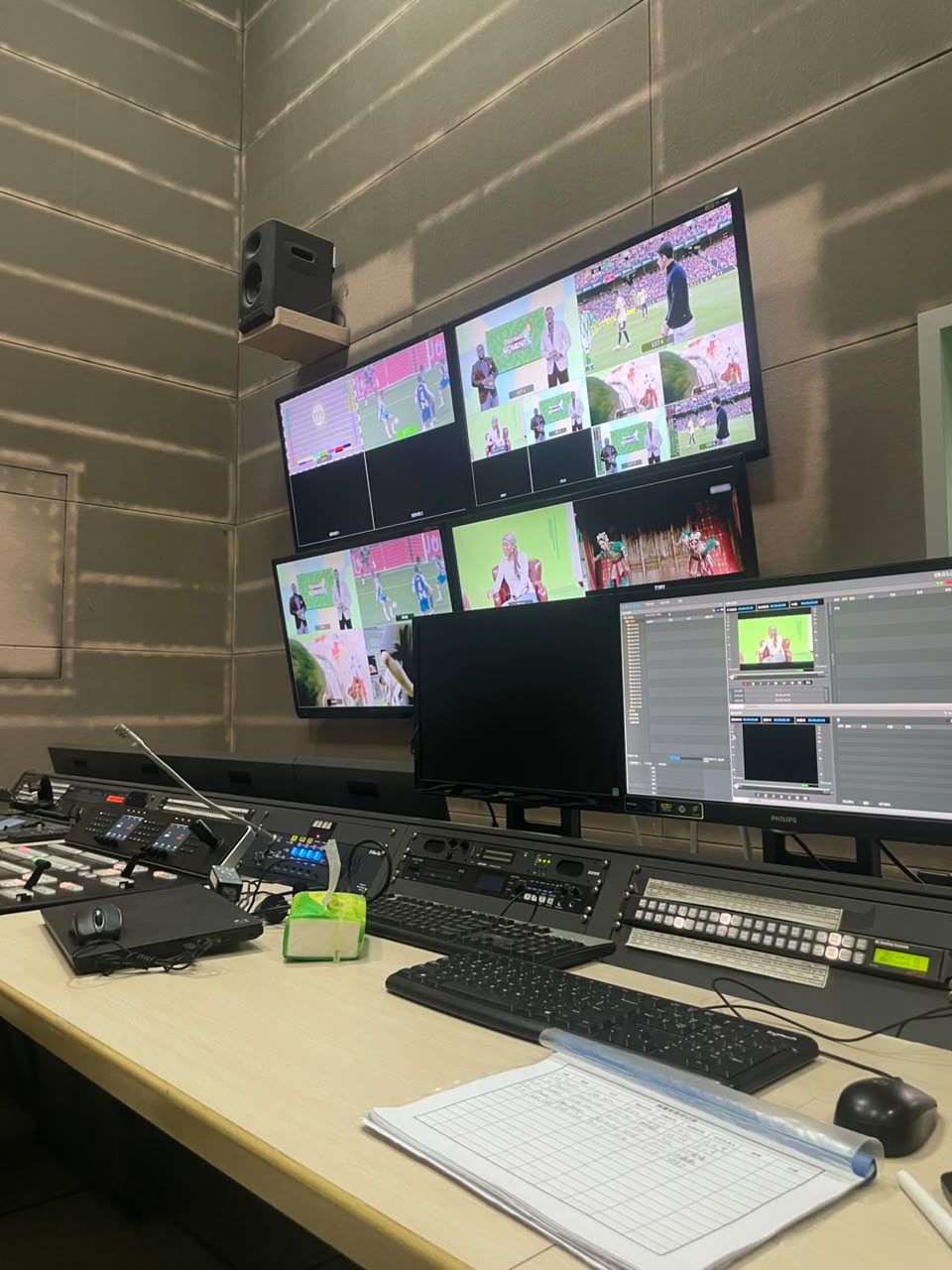
Working in a professional dubbing studio allowed me to see how technology sits at the centre of modern content production.
The studio was fully soundproof and equipped with professional recording and monitoring equipment.
But the technology itself was only one part of the process.
A finished programme required coordination between translators, editors, voice performers, sound engineers and other production staff.
This changed the way I thought about digital media.
From the outside, viewers may only see a finished television programme. Behind that programme is a workflow involving language, software, hardware, people, deadlines and quality control.
The experience also taught me that localization is becoming increasingly important as media companies distribute content across borders.
A programme created for one market cannot always simply be translated word-for-word for another.
Language carries culture, humour, emotion and context.
Technology can accelerate the process, but people still have to make decisions about meaning and audience.
AI is becoming part of the workplace
One of the most interesting aspects of my internship was observing the growing role of artificial intelligence in everyday work.
AI was increasingly relevant to tasks such as translation, script preparation, information organization, and other routine activities.

For someone working with language and content, this was particularly fascinating.
The discussion around AI is often framed around whether machines will replace human workers.
My experience gave me a slightly different perspective.
I saw AI more as another layer of the workplace—one that can make certain tasks faster but still requires people to supervise, evaluate and refine the results.
This is especially important when working across languages and cultures.
A machine may produce a technically accurate translation, but accuracy is not always the same as meaning.
A phrase can be grammatically correct and still sound unnatural. A cultural reference can be translated literally and lose its significance. A line delivered by a character may require emotional interpretation that goes beyond the words on the screen.
That experience reinforced something I had been learning through my MBA studies: technology changes processes, but people remain responsible for how those processes are managed.
Working inside Beijing’s technology ecosystem
The technology environment surrounding my internship was almost as interesting as the work itself.
StarTimes is located in Beijing’s Yizhuang Economic-Technological Development Area, an important technology and industrial cluster.
Yizhuang is associated with sectors including artificial intelligence, intelligent connected vehicles, digital technology and advanced manufacturing.

The area is home to major technology and business players, including Xiaomi and JD.com, while autonomous-driving technology has also become increasingly visible in the district.
For an international student studying business, this created a unique learning environment.
I could be working on television content during the day and then step outside into an environment where autonomous vehicles, artificial intelligence and other emerging technologies were part of the surrounding business ecosystem.
It made China’s technology development feel much more tangible.
Technology was not simply something I was reading about in an MBA classroom or seeing in international news.
It was part of the physical and commercial environment around me.
A global workforce in one office
Technology may connect businesses, but people are still at the centre of international organizations.
During my internship, I interacted with colleagues from Kenya, Tanzania, Burundi, Gabon and Ghana, as well as colleagues from China, Scotland and England.
For me, this was one of the most interesting aspects of the experience.
A modern company operating across borders needs more than technology.
It needs people who understand different markets and cultures.
My Kenyan experience became particularly useful because I understood the local African context, while my colleagues brought knowledge of other markets and cultures.
The experience also reminded me that Africa is not one single market.
The way audiences consume media, respond to content and interact with technology can differ significantly from one country to another.
Technology may provide the infrastructure for global distribution, but understanding the people receiving the content remains essential.
Learning from life outside the office
My internship experience was also shaped by the environment in which I lived.
I stayed in company accommodation that was closer to a hotel than a traditional student dormitory.
The company canteen also made daily life extremely convenient.
These facilities may sound like small details, but they became an important part of my experience.
They gave me more opportunities to interact with colleagues outside formal work situations, and I made many new Chinese friends during my time in Beijing.
Those relationships gave me a different understanding of China.
Technology and business statistics can tell you a lot about a country, but personal interaction tells you something different.
Living and working in China allowed me to experience the country beyond what I encountered in textbooks, lectures and news reports.
A China–Kenya project brought everything together
One of the most meaningful projects I participated in involved China–Kenya cooperation.
The project presented Kenya’s landscapes, culture and tourism attractions to a Chinese audience.
My role involved preparing Swahili-to-English subtitles and subsequently working with Chinese colleagues on the Chinese version.
The project brought together almost everything that defined my experience in Beijing: language, technology, media, culture and international collaboration.
It also demonstrated the potential role of digital media in connecting countries.
International cooperation is often discussed through the language of trade, investment and infrastructure.
But information also needs to move between countries.
Stories need to be translated.
Cultures need to be explained.
Audiences need to understand one another.
Digital media can help create that connection.
Turning the workplace into a research environment
My internship also became part of my MBA research journey.
While working at StarTimes, I collected data for my thesis and conducted interviews with employees, including a pilot interview with a sound engineer.
This was valuable because I was simultaneously experiencing and studying the workplace.
The research process strengthened my ability to prepare questions, conduct interviews, listen actively and identify useful information.
It also showed me how academic research and professional experience can complement each other.
Instead of studying organizational behaviour only through academic theories, I could observe how people, technology and organizational processes interacted in a real workplace.
What China taught me about the future of work
I would not suggest that my experience represents every Chinese company.
However, my internship changed the way I think about the Chinese workplace and the future of work more generally.
The first lesson was that technology adoption is becoming a workplace reality rather than a distant concept.
AI is increasingly being integrated into everyday processes.
The second was that technology does not remove the need for human collaboration.
If anything, international workplaces may require stronger communication skills as technology makes it easier for people and organizations to operate across borders.
The third was the importance of adaptability.
Employees increasingly need to be comfortable learning new tools, working with people from different backgrounds and adjusting to changing processes.
These lessons extend far beyond the media industry.
Two StarTimes experiences, two perspectives
Perhaps what made the Beijing internship particularly meaningful was that it followed my three years of experience at StarTimes Kenya.
The two experiences gave me two different perspectives on the same organization.
Kenya taught me about working within an African market.
Beijing exposed me to a broader international environment and gave me a closer perspective on the headquarters side of the organization.
Together, they helped me understand that global business is not simply about having operations in multiple countries.
It is about connecting those countries.
It is about understanding local markets while maintaining a broader organizational vision.
And increasingly, it is about using technology to make those connections faster and more efficiently.
More than an internship
When I arrived in Beijing, my internship was primarily a requirement of my MBA practical education.
By the end of the experience, it had become something much bigger.
I gained practical experience in media production, audiovisual translation, dubbing and content localization. I gained exposure to AI-assisted workflows and professional technology. I collected data for my thesis. I worked with colleagues from different countries and made new Chinese friends.
Most importantly, I gained perspective.
I had already experienced StarTimes from Kenya.
Beijing allowed me to step back and see the organization within a much larger international and technological ecosystem.
For me, that is one of the greatest advantages of international education.
You do not simply learn about another country.
You participate in it.
You work with its people. You use its systems. You experience its technology. You adapt to its environment. And sometimes, you discover that the most valuable lessons happen outside the classroom.
My journey from StarTimes Kenya to an internship in Beijing ultimately taught me something that applies far beyond television:
The future of global business will not be shaped by technology alone. It will be shaped by how effectively people, cultures, and technology learn to work together.